

-
144
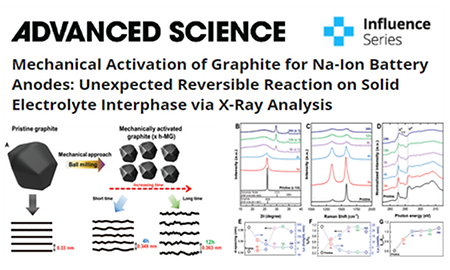
- Mechanical Activation of Graphite for Na-Ion Battery Anodes: Unexpected Reversible Reaction on Solid Electrolyte Interph
- Mechanical Activation of Graphite for Na-Ion Battery Anodes: Unexpected Reversible Reaction on Solid Electrolyte Interphase via X-Ray Analysis The research team led by Professor Seong Chan Jun of the Department of Mechanical Engineering (First author of this study are Su Chan Lee) and Dr. Chung KIST's team conducted a joint study under the theme of 'Mechanical Activation of Graphite for Na-Ion Battery Anodes: Unexpected Reversible Reaction on Solid Electrolyte Interphase via X-Ray Analysis'. In this paper, the sodium ion storage capacity of graphite was greatly improved through mechanical activation. The research team produced graphite with a defective structure using a ball milling technique, and analyzed its electrochemical performance using it as an SIB cathode. As a result, the activated graphite exhibited a sodium ion storage mechanism distinct from that of hard carbon. In the activated graphite, simultaneous reactions occurred at both the surface and bulk levels, with reversible reactions of Na2CO3 and NaF occurring on the SEI surface. This process enhanced the sodium storage performance by acting as an auxiliary sodium reservoir on the defect-rich carbon surface. The study demonstrated that the defect-rich carbon electrodes offer a new reaction mechanism characterized by unexpected reversible reactions on the SEI surface. This study was published in the world-renowned international journal 'Advanced Science' (Impact Factor: 15.1). The link: https://doi.org/10.1002/advs.202401022
- 기계공학부 2024.05.22
-
143
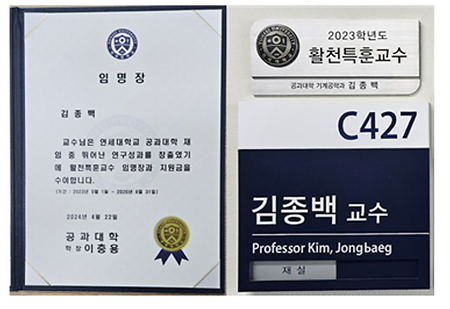
- Professor Jongbaeg Kim's Appointment as the 2023 Hwalchun Distinguished Professor of the Yonsei University College of En
- Professor Jongbaeg Kim's Appointment as the 2023 Hwalchun Distinguished Professor of the Yonsei University College of Engineering Professor Jongbaeg Kim from the department of mechanical Engineering has been appointed as the 2023 Hwalchun distinguished professor of Yonsei university college of engineering. This honor is awarded based on evaluations of publications in international journals, research impact, research funding achievements, as well as contributions to education and service. The Hwalchun distinguished professor program provides benefits including financial incentives to researchers who have made substantial research and service contributions to the college ofengineering at Yonsei university. For the year 2023, a total of two professors from the college of engineering have been selected for the Hwalchun distinguished professor
- 기계공학부 2024.05.22
-
142
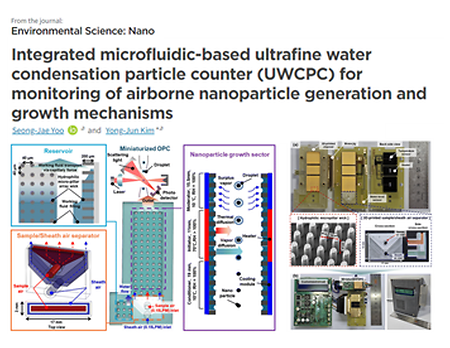
- Development of integrated microfluidic-based ultrafine water condensation particle counter (UWCPC) for monitoring of air
- Development of integrated microfluidic-based ultrafine water condensation particle counter (UWCPC) for monitoring of airborne nanoparticle generation and growth mechanisms Research team led by Professor Yongjun Kim of the Department of Mechanical Engineering and the first author, Dr. Seongjae Yoo introduced a microfluidic-based ultra-fine water condensation particle counter (UWCPC) made with PCB and 3D printing technology. UWCPC is a low-cost, miniaturized microfluidic device for monitoring nanoparticle generation and growth mechanisms in atmosphere. This device consists of a sheath/sample air separation unit, a nanoparticle growth section, and a small optical particle counter, and is capable of measuring particles down to 3.4nm diameter, due to optimized design determined by simulation. This research has been published as a cover article in renowned international academic journal 'Royal Society of Chemistry' (Impact Factor: 7.3) in April 2024. The link: https://doi.org/10.1039/D3EN00686G
- 기계공학부 2024.05.22
-
141
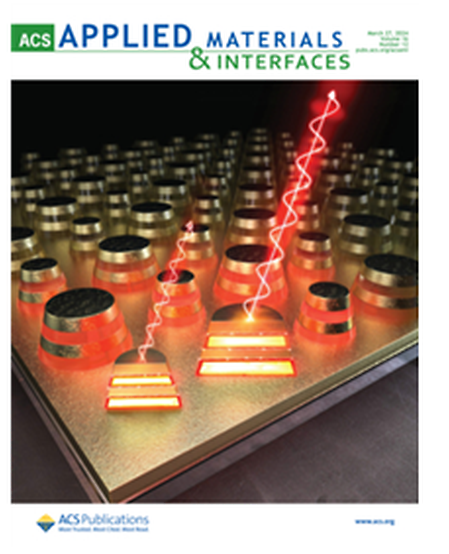
- Multiresonant Selective Emitter with Enhanced Thermal Management for Infrared Camouflage
- Multiresonant Selective Emitter with Enhanced Thermal Management for Infrared Camouflage A research team led by Professor Hyung Hee Cho from the Department of Mechanical Engineering has developed an infrared selective emitter using a multi-diameter, multi-layer metal-dielectric-metal structure and evaluated its camouflage performance. The team confirmed that the fabricated structure could reduce the infrared signal by 72% and 83% in the 3-5 μm and 8-12 μm infrared detection bands, respectively, compared to a blackbody. The research results were published as a cover article in the March 2024 issue of the internationally renowned journal 'ACS Applied Materials & Interfaces' (Impact Factor: 9.5). The link: doi.org/10.1021/acsami.3c15504
- 기계공학부 2024.05.22
-
140
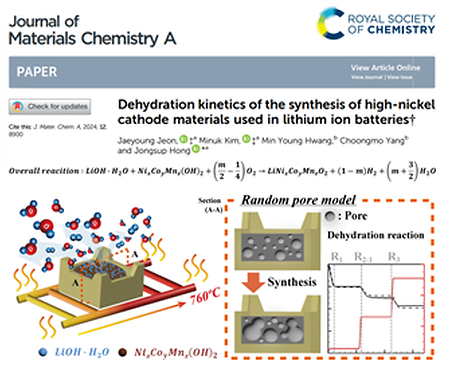
- A study on the dehydration reactions analysis of cathode material sintering process for enhancing the performance and du
- A study on the dehydration reactions analysis of cathode material sintering process for enhancing the performance and durability of lithium-ion batteries The research team, led by Professor Hong Jongseop from the Department of Mechanical Engineering (co-first authors of this study are Jaeyoung Jeon and Minuk Kim), has collaborated with the RIST Secondary Battery Materials Research Institute to analyze dehydration reactions occurring during the sintering process of high Ni-based cathode materials. Dehydration reactions of each cathode material precursor were identified based on in-situ XRD and TGA-MS experiments, and the reaction rates of three identified dehydration reactions were analyzed using the Random Pore Model. This research has been published in the renowned international academic journal 'Journal of Materials Chemistry A' (Impact Factor: 11.9 as of 2022, ranking in the top 8.8% in the JCR Energy & Fuels category). The link: https://doi.org/10.1039/D3TA07579F
- 기계공학부 2024.05.22
-
139
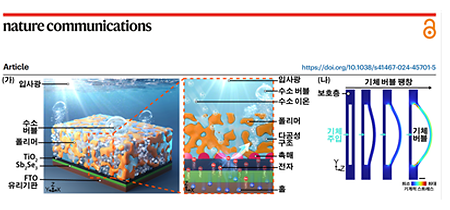
- Investigation of mechanism of enhancement of structural stability in photoelectrodes through porous gel layer coating
- Investigation of mechanism of enhancement of structural stability in photoelectrodes through porous gel layer coating To address the climate crisis, research on commercializing "photoelectrodes" that generate hydrogen energy without carbon emissions is gaining significant attention. Professor Hyungsuk Lee’s research team from School of Mechanical Engineering, in collaboration with Professor Jooho Moon’s team from Department of Materials Science and Engineering, reported a study about the identification of a mechanism by which a hydrogel-based protection layer help to prevent the structural damage to photoelectrodes for generating hydrogen gas using sunlight and water. Hydrogen gas molecules generated in the photoelectrodes form gas bubbles over a critical concentration, applying mechanical stress to the electrode surface and causing structural degradation of the electrode surface. A recent study demonstrated that the coating of the hydrogel, which is a three-dimensional polymer containing water, could enhance the structural integrity of the photoelectrodes. In this study, we elucidated the effect of the porous structure of the hydrogel and the dynamic behavior of bubbles in the gel on the structural stability of the electrode. The porous structure of the hydrogel was controlled via cryogelation technique. Through theoretical and numerical analysis of the dynamic behavior of hydrogen bubbles within the porous material, we revealed that control of the dynamic behavior of gas bubbles trapped in the protective layer is required to develop the durable photoelectrodes. This study was published in Nature Communications (Impact Factor: 16.6 / Percentile rank: 7.5%) on February 19. The link: https://www.nature.com/articles/s41467-024-45701-5
- 기계공학부 2024.05.22
-
138
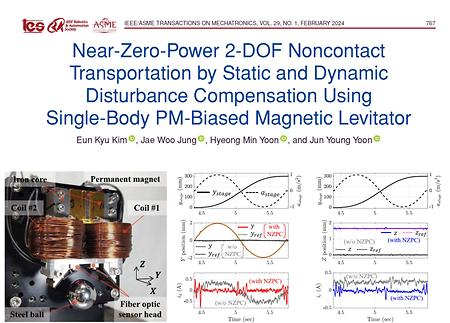
- Near-zero-power Control Method for High-throughput Non-contact Transportation Utilizing 2-DOF PM-biased Magnetic Levitat
- Near-zero-power Control Method for High-throughput Non-contact Transportation Utilizing 2-DOF PM-biased Magnetic Levitator The research team, led by Professor Jun Young Yoon from the Department of Mechanical Engineering (first author of this study is Eun Kyu Kim), has studied near-zero-power control method of the 2-DOF magnetic levitator during high-throughput non-contact transportation. It has been demonstrated that the proposed 2-DOF permanent-magnet-biased magnetic actuator can be utilized to reject the static and dynamic disturbance without nominal current consumption during non-contact transportaion, showing a significant potential for industrial applications where high-throughput transportation tasks are required in a non-contact manner. This research has been published in the renowned international academic journal 'IEEE/ASME Transactions on Mechatronics' in Feburary 2024. The link: https://ieeexplore.ieee.org/abstract/document/10179114
- 기계공학부 2024.03.20
-
137
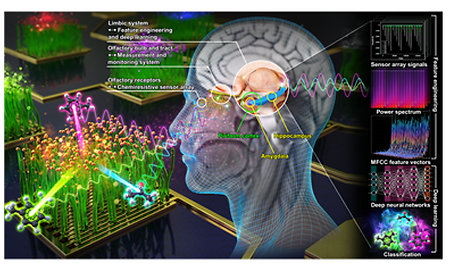
- Data-centric artificial olfactory system based on the eigengraph
- Data-centric artificial olfactory system based on the eigengraph The research team of Professor Seong Chan Jun of the Department of Mechanical Engineering (first author, Master Seung-Hyun Sung, contributing author Yun Ji Hwang), the research team of Professor Ho Won Jang of the Department of Materials Science and Engineering at Seoul National University (co-first author, PhD Jun Min Suh), and Jeon Gue Park, CEO of Tutorus Labs Inc. have conducted joint research on the topic of 'Data-centric artificial olfactory system based on the eigengraph'. In this paper, they developed and integrated sensor arrays, electrochemical measurement devices and artificial intelligence algorithms that correspond to the functions of the olfactory receptors and each region of the brain responsible for the human olfactory mechanism to implement a data-centric artificial olfactory system and its standard model was presented. The law of existence of the eigengraph in electrochemistry was proven and declared for the first time in the world by capturing the unique electrochemical reaction that naturally exists between sensing materials and gas molecules. Based on the waveform analysis principle for eigengraphs, they have shown that various types and mixed states of gas molecules can be identified with nearly 100% accuracy even in all weather and unknown environments by extracting odor characteristics necessary for the identification of gas molecules through mathematical algorithms. They explained that this is the result of overcoming the limitations of existing sensitivity-dependent artificial olfactory technology that is vulnerable to external environmental changes. This technology can be applied and used in a wide range of fields, including artificial intelligence robots, space exploration, home appliance industry, defense industry, and forensic investigation. This study was published in a world-renowned international academic journal 'Nature Communications' (Impact Factor: 17.694). The link: doi.org/10.1038/s41467-024-45430-9
- 기계공학부 2024.03.20
-
136
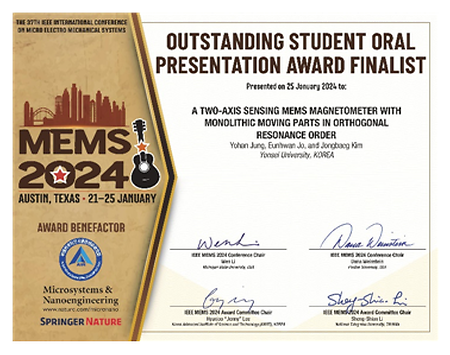
- Development of Two-Axis MEMS Magnetic Field Sensor Using an Eccentric Resonator
- Development of Two-Axis MEMS Magnetic Field Sensor Using an Eccentric Resonator Professor Jongbaeg Kim's research team has successfully developed a two-axis MEMS magnetic field sensor using an electromagentic inductor and an eccentric resonator driven by electrostatic forces. This approach allowed for the realization of a resonator that resonates in orthogonal directions by altering the sensor's operating frequency, thereby experimentally validating the capability for two-axis magnetic field detection. This work was presented at the 2024 37th IEEE MEMS Conference organized by the Institute of Electrical and Electronics Engineers (IEEE), highlighting its significance within the community. Additionally, the research earned distinction as a finalist for the Outstanding Student Oral Presentation Award, an accolade bestowed upon only 19 of the 659 papers submitted, acknowledging its excellence and contribution to the field. The link: https://ieeexplore.ieee.org/document/10439558
- 기계공학부 2024.03.20
-
135
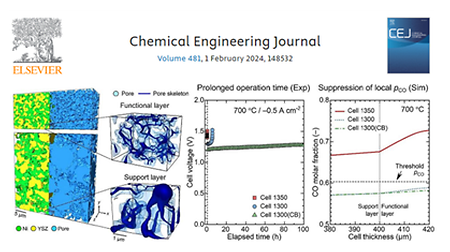
- Microstructural Improvement of High-Temperature Solid Oxide Electrolysis Cells for High-Efficiency and High-Stability Ca
- Microstructural Improvement of High-Temperature Solid Oxide Electrolysis Cells for High-Efficiency and High-Stability Carbon Dioxide Electrolysis The research team, led by Professor Jongsup Hong from the Department of Mechanical Engineering (co-first author is Wooseok Lee) collaborated with Dr. Yoon Kyung-joong's team from KIST and Professor Lee Kang-taek's team from KAIST to improve the stability of solid oxide electrolysis cells (SOEC) that convert greenhouse gas carbon dioxide into high-value fuels. They solved the problem of carbon deposition caused by poor gas diffusion through improvement of the microstructure of the fuel electrode and elucidated the stability improvement mechanism based on FIB-SEM analysis and multi-physics computational analysis. This research has been published in Chemical Engineering Journal, a top-tier journal in the fields of thermal and reaction engineering (as of 2022, with an impact factor of 15.1, ranking in the top 3.2% in the JCR Engineering, Chemical section), recognizing its qualitative excellence. The link: https://doi.org/10.1016/j.cej.2024.148532
- 기계공학부 2024.03.20